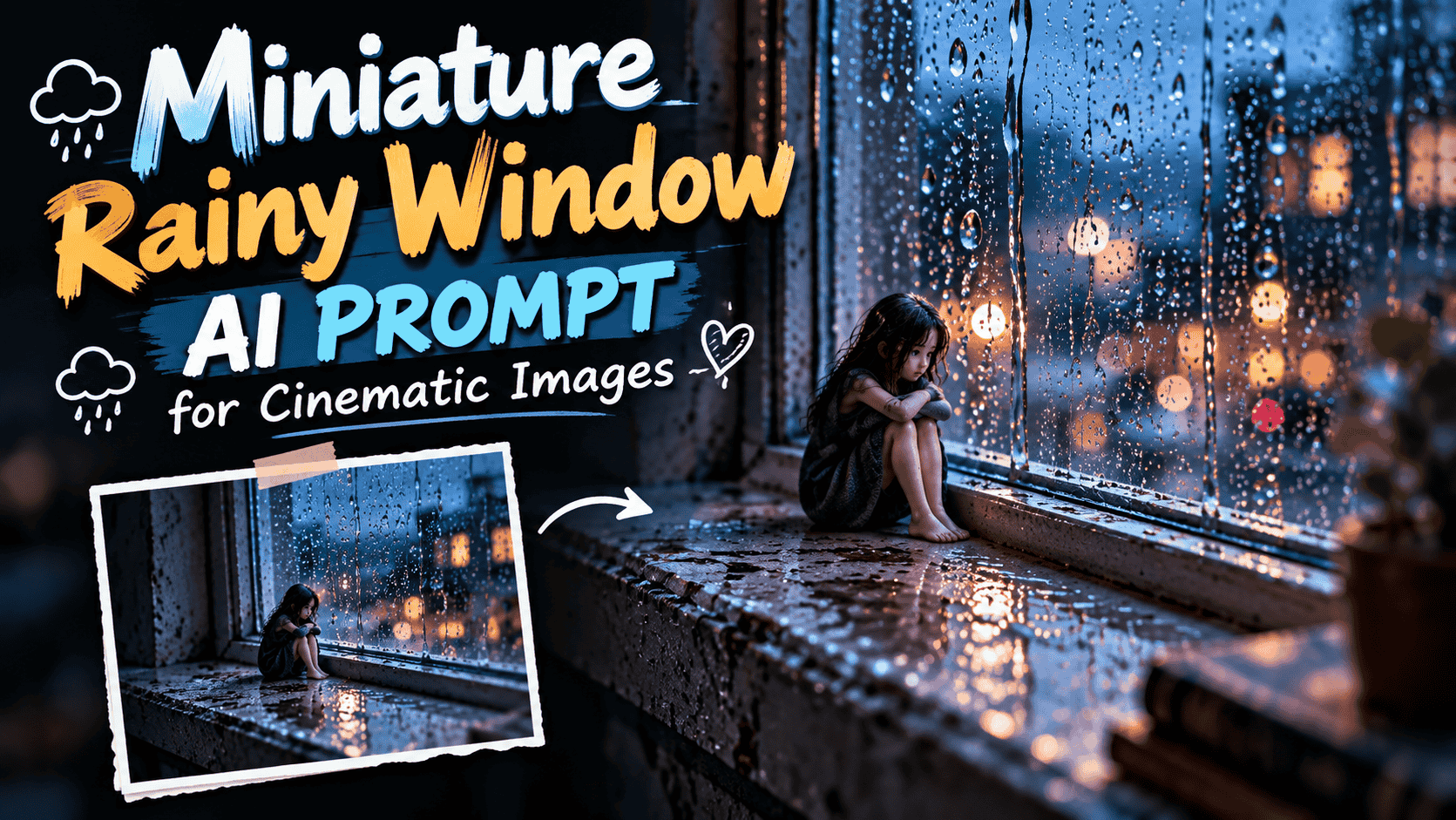
Featured image for: Miniature Rainy Window AI Prompt: Create a Cinematic Tiny Girl Scene
Creating an emotional AI image does not always require dramatic action or complicated scenery. Sometimes a tiny character, a rain-covered window, and a quiet blue atmosphere can tell an entire story. With tools such as ChatGPT, creators can develop detailed image prompts that define scale, emotion, lighting, composition, and photographic style before generating the final visual. A Miniature Rainy Window AI Prompt is especially effective because it combines photorealistic miniature photography with emotional storytelling. The oversized rainy window, tiny lonely girl, wet reflections, and muted blue palette create a cinematic image that immediately communicates solitude and peaceful melancholy.
This style is ideal for creators who want AI-generated images that feel more like carefully photographed miniature dioramas than conventional digital artwork.
The key is getting the relationship between the character and her environment right.
What Is a Miniature Rainy Window AI Image?
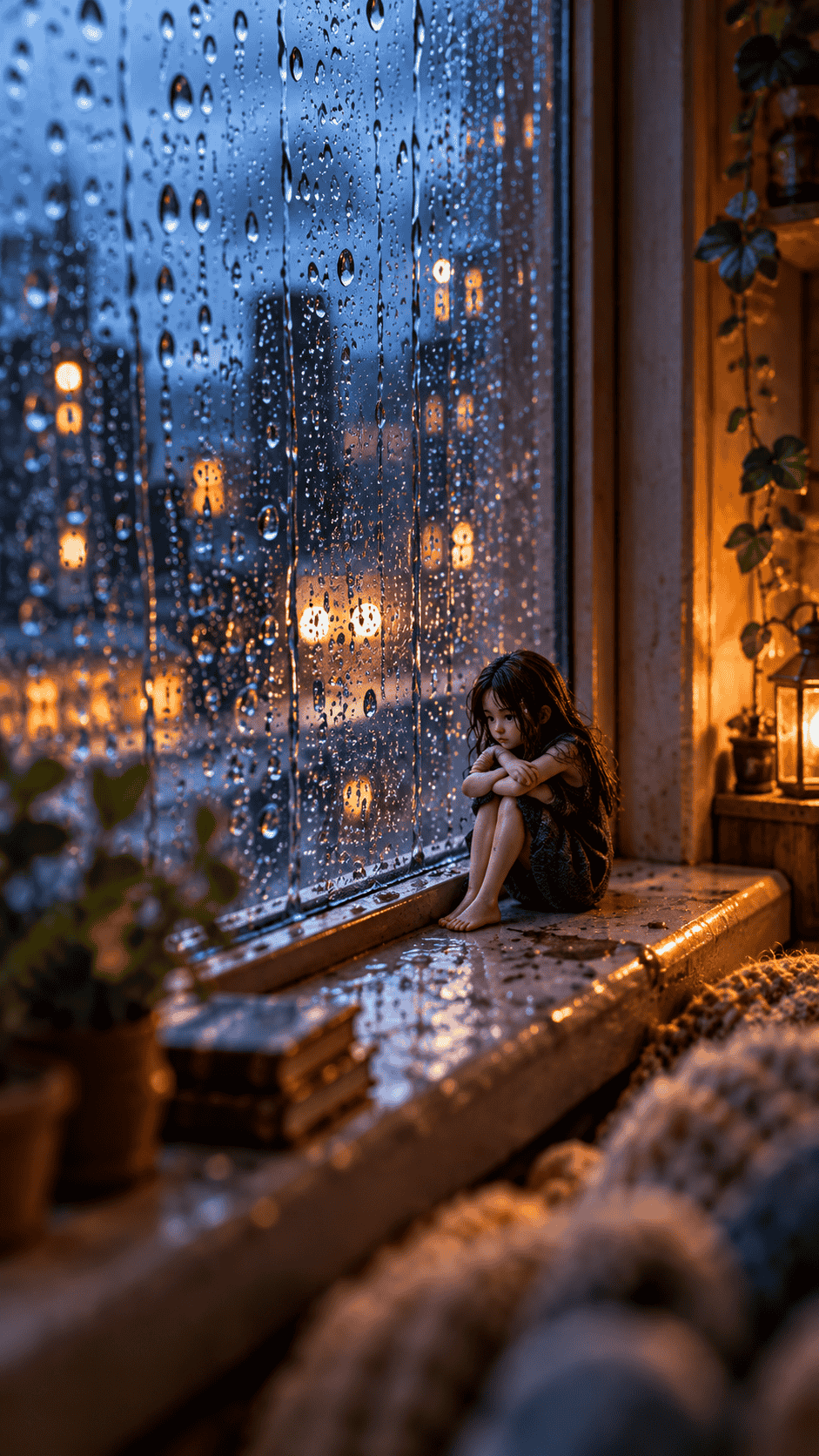
A miniature rainy window image creates the illusion that a very small human character exists inside an otherwise normal-sized environment.
In this concept, a doll-sized young woman sits alone on a wide windowsill while rain falls outside. Instead of making the girl dominate the frame, the large window becomes the primary environmental element.
The girl appears extremely small in comparison.
Hundreds of raindrops cover the glass. Water slowly travels downward in irregular trails, while the distant city outside disappears into soft blue-gray blur.
This difference in scale is what gives the image its miniature identity.
The result should not look like a normal woman sitting beside a window. It should feel as though a photographer has built a tiny handcrafted character and environment, placed them beside an enormous rain-covered glass surface, and photographed everything using a macro lens.
ChatGPT Prompts
Miniature Rainy Window AI Prompt
Cinematic photorealistic miniature diorama of a tiny doll-sized young woman sitting alone on the inner ledge of a large old window during a rainy evening. The girl is extremely small compared to the window, clearly appearing as a miniature human figure, sitting curled up with both knees pulled close to her chest, arms wrapped gently around her legs, head slightly lowered, looking quietly outside with a sad, thoughtful and lonely expression. Long dark slightly messy hair falling naturally around her face, simple dark oversized clothing, barefoot.
The huge window dominates the composition, covered with hundreds of realistic rain droplets, tiny beads of water and long vertical water trails running down the cold glass. Heavy rain visible outside, distant city environment completely blurred into soft blue-gray bokeh. Cool deep navy and desaturated blue color palette, dim overcast rainy-day lighting, soft natural light entering through the window and gently illuminating the miniature girl.
Wide thick weathered windowsill with realistic wet texture, tiny puddles and subtle reflections around the girl. Strong sense of scale — the girl should look extremely tiny against the enormous window frame and oversized raindrops. Melancholic, peaceful, lonely rainy-day atmosphere, emotional visual storytelling, lots of negative space around the miniature character.
Shot like professional macro miniature photography, 100mm macro lens aesthetic, very shallow depth of field, selective focus on the tiny girl and nearby raindrops, foreground and background gradually blurred, cinematic framing, realistic glass reflections, volumetric rainy atmosphere, subtle film grain, handcrafted miniature diorama details, realistic skin and hair texture, natural imperfections, premium photography, dark moody exposure, soft shadows, photorealistic, highly detailed, no cartoon look, no anime, no plastic doll appearance, no oversized human, no warm orange lighting, no text, no watermark, no artificial AI look.
Click copy to use in ChatGPT Prompts
Complete Step-by-Step Editing Workflow
Copy the prompt: Use the dedicated copy button above to get the prompt.
Open your editing tool: Use your preferred AI image generator (ChatGPT, Google Gemini, Midjourney, or Bing).
Personalize the variables: Adjust background, clothing, lighting, pose, or mood according to your requirements.
Generate & refine: Generate the image and tweak small details if needed.
Export: Save the final high-quality output for your social media.
Curates practical AI prompts, photo-editing resources, video-editing ideas, and creator-focused tutorials to help readers create top-quality digital content.
Super helpful prompt! The lighting and peacock feather crown came out incredible on Bing Image Creator.
Priya PatelAugust 31, 2026
Thank you PromptCopyAI! Shared this with all my photo editing groups.
The prompt may look detailed, but its structure is intentional. Each group of instructions controls a different part of the final image.
Creating a Strong Miniature Scale
The most important part of this concept is scale.
The character must appear genuinely tiny.
If the image generator interprets the prompt as a normal portrait, the emotional composition may still look attractive, but the miniature effect will disappear.
That is why the prompt repeatedly establishes the relationship between the character and window using descriptions such as “tiny doll-sized young woman,” “extremely small compared to the window,” and “miniature human figure.”
The window should visually overwhelm the character.
Large window frames, oversized raindrops, a broad windowsill, and generous empty space around the girl help communicate her tiny size without requiring artificial visual tricks.
Think of the character as one small element inside a much larger environment rather than the conventional hero of a portrait.
Why the Girl Should Not Fill the Frame
Traditional portrait photography often places a person prominently in the frame.
Miniature photography works differently.
If the girl occupies half of the image, viewers may interpret her as a normal-sized person. Making her occupy only a small portion of the composition immediately changes that perception.
The surrounding environment provides the scale reference.
An enormous window frame behind her, water droplets that appear large in relation to her body, and a wide empty windowsill make her size understandable at first glance.
This is also why negative space is important.
Empty space is not wasted space in this composition. It reinforces loneliness, scale, and visual storytelling simultaneously.
Make the Rainy Glass a Major Visual Element
Rain should not simply exist somewhere in the background.
The glass itself needs to feel wet.
The prompt describes hundreds of droplets, tiny beads of water, and vertical water trails because real rain rarely creates a perfectly uniform pattern.
Some droplets remain round.
Others join together.
Larger drops travel down the glass and leave thin irregular trails behind.
When these different forms appear together, the window becomes far more believable.
Reflections from the distant environment can also interact with the wet glass. A small amount of reflected city light within individual droplets creates beautiful visual detail without making the scene overly bright.
Use Blue Tones to Establish the Mood
Color plays a major role in this particular visual.
Instead of a traditional cozy rainy scene filled with warm lamps and orange light, this concept uses deep navy, desaturated blue, gray, and cool natural light.
The palette supports the character's thoughtful and lonely mood.
It also prevents the image from becoming a generic cozy-room visual.
Rainy evening light naturally lends itself to cool tones. Soft blue illumination coming through the window can gently reveal the girl’s silhouette, face, hair, and clothing without making the scene look artificially lit.
Dark does not mean completely black.
Important details should remain visible inside the shadows.
The goal is a restrained, cinematic exposure rather than an underexposed image where the character disappears.
Give the Character a Natural Emotional Pose
The pose contributes heavily to the story.
The girl sits with her knees close to her chest and her arms wrapped around them. Her head is slightly lowered as she quietly looks toward the rainy exterior.
This closed body language naturally communicates introspection.
There is no need for exaggerated crying, tears, or dramatic facial expressions.
A subtle thoughtful expression can often communicate sadness more effectively.
Long, slightly messy hair also supports the natural atmosphere. It should fall imperfectly around the face rather than looking like a polished fashion hairstyle.
Bare feet and oversized dark clothing make the scene feel vulnerable, quiet, and informal.
All these details support one emotional direction without overloading the character design.
Macro Photography Makes the Miniature Effect Convincing
One of the strongest technical instructions in this prompt is the 100mm macro lens aesthetic.
Macro photography is commonly associated with close-up photographs of very small subjects.
As a result, it provides visual cues that help sell the miniature illusion.
The character and nearby droplets can remain detailed while areas closer to and farther from the focal plane gradually become blurred.
This narrow focus creates the feeling that the camera is physically close to a very small subject.
If everything from the foreground to the distant city remains perfectly sharp, the scene can start looking like a 3D render.
Using Gemini to Develop Alternative Scene Variations
Once the core composition works, creators can also use tools such as Geminito brainstorm variations while preserving the same miniature concept.
For example, instead of completely rewriting the image, you could keep the tiny girl and rainy window unchanged while experimenting with different environments outside.
One version might show an indistinct rainy city.
Another could show distant apartment lights through heavy rain.
A third could replace the urban environment with a foggy landscape.
The important point is consistency.
Changing too many variables simultaneously can destroy the visual identity of the original concept. Keep the tiny scale, emotional pose, wet window, macro photography, and cool color treatment consistent while experimenting with only one or two secondary elements.
Create Realistic Wet Surfaces
The windowsill should also participate in the rainy atmosphere.
A completely dry, perfectly clean ledge can feel disconnected from a heavily rain-covered window.
Instead, use subtle moisture, small puddles, damp textures, and restrained reflections.
These details should remain believable.
The entire windowsill does not need to become flooded.
Small areas of reflected blue light or tiny wet patches are enough to connect the character physically to the environment.
Weathered materials can add another level of realism.
A slightly aged wooden, concrete, or painted windowsill with minor surface imperfections feels more authentic than a perfectly smooth digital surface.
Use Bokeh Instead of a Detailed City
The city outside does not need to compete with the character.
Keeping distant architecture heavily blurred allows viewers to understand the setting without studying individual buildings.
Soft blue-gray bokeh is particularly effective.
Occasional diffused lights can appear through the rain, but they should remain subtle.
The window, droplets, and tiny character should still carry the visual story.
This also creates depth: sharp nearby droplets sit in front of a softer miniature figure, while the distant exterior becomes even more blurred.
That gradual transition creates a convincing photographic space.
Why Natural Imperfections Improve AI Images
Photorealism does not mean perfection.
Real photography contains small irregularities.
Hair strands do not always fall symmetrically. Clothing develops folds. Water droplets vary in size. Old window frames have subtle marks. Reflections are uneven, and low-light photography may contain gentle grain.
Adding these characteristics can reduce the polished synthetic appearance sometimes associated with AI-generated images.
The phrase “natural imperfections” is therefore useful in this prompt.
Subtle film grain can also complement the rainy atmosphere, provided it does not become so strong that facial or environmental details disappear.
Keep the Image Free from Unnecessary Elements
One of the easiest ways to weaken this composition is to add too many decorative objects.
The emotional story is intentionally simple:
A tiny girl.
A huge window.
Rain.
A distant world outside.
That is enough.
Warm table lamps, large flower arrangements, bright décor, excessive books, colorful furniture, or complex bedroom details can pull attention away from the main idea.
Minimalism makes the character’s isolation more noticeable.
It also gives the raindrops and negative space enough room to become important visual elements.
How to Keep the Image Photorealistic
For this style, avoid pushing every quality-related keyword to the extreme.
Terms such as “ultra-sharp,” “perfect,” “flawless,” and excessive HDR instructions can work against the desired mood.
Instead, focus on photographic characteristics.
Natural light, selective focus, realistic moisture, subtle grain, soft shadows, macro depth of field, authentic materials, and controlled exposure are more valuable.
The final result should look like a carefully photographed miniature set, not an aggressively processed fantasy render.
The negative instructions also help maintain this direction: no cartoon appearance, no anime styling, no plastic doll texture, no text, and no artificial-looking surfaces.
Best Composition for This Miniature Scene
A vertical composition works particularly well for this concept.
The large window can occupy most of the frame while the girl sits relatively low or slightly off-center.
This gives the rain-covered glass enough room to establish the atmosphere.
Positioning the character away from the exact center can also make the image feel more cinematic.
The viewer’s eye first notices the scale of the environment, then discovers the tiny girl sitting quietly within it.
That visual discovery is part of what makes miniature artwork engaging.
For website thumbnails, a wider crop can also work, provided the girl remains visible and the oversized window still dominates the composition.
Creating Variations Without Losing the Original Style
After generating a successful base image, variations should remain controlled.
You might change the time from rainy evening to early morning, increase the fog outside, make the window frame older, introduce slightly stronger reflections, or move the tiny character farther along the ledge.
You could also experiment with the character looking directly through the window instead of downward.
However, the core identity should remain unchanged:
tiny human scale, oversized rainy window, blue-gray atmosphere, emotional pose, macro photography, shallow focus, and cinematic realism.
These elements define the style more strongly than decorative details.
Final Thoughts on the Miniature Rainy Window AI Prompt
A strong Miniature Rainy Window AI Prompt works because it combines technical photography instructions with a simple emotional story.
The tiny girl gives viewers a subject to connect with, while the enormous rain-covered window emphasizes both scale and isolation.
Cool blue tones establish the mood. Realistic water droplets make the environment tactile. Negative space strengthens the composition, and macro depth of field makes the miniature illusion believable.
Most importantly, the scene does not need excessive decoration.
Its strength comes from restraint.
For creators building AI prompt libraries or experimenting with image-generation platforms such as GoogleGlow, this concept can also become a useful foundation for an entire series. The same visual language can be adapted into rainy cafés, miniature bedrooms, tiny railway windows, foggy cabins, old libraries, or small apartment balconies while retaining the cinematic diorama aesthetic.
Start with a clear scale relationship, define one strong emotional action, control the lighting and color palette, and use photography terms only where they meaningfully affect the image.
When those elements work together, the final visual can feel less like a conventional AI illustration and more like a real photograph of a tiny, quiet world captured on a rainy evening.
Janam Janam Couple AI Dance Video Prompt: Create Cinematic Romantic Dance Videos in Flow AI